
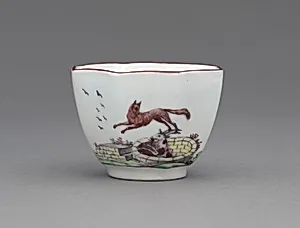
Beaker
Medium
Soft-paste porcelain
Dimensions
Height (teapot .445a, b): 5 in. (12.7 cm); Diameter (waste bowl .446): 4 1/8 in. (10.5 cm); Width (cups .447, .448): 2 1/2 in. (6.4 cm); Diameter (saucers .449, .450): 4 1/4 in. (10.8 cm)
Classification
Ceramics-Porcelain
Culture
British, Chelsea
Department
European Sculpture and Decorative Arts
Museum
Metropolitan Museum of Art, New York, NY
Credit
Gift of Irwin Untermyer, 1964
Accession Number
64.101.451
Rights
Public Domain
Art Historical Context
This elegant beaker, crafted around 1752–55 at the Chelsea Porcelain Manufactory in London, exemplifies the early success of British porcelain production. Created in soft-paste porcelain—a delicate, translucent material developed to mimic prized Chinese imports—the piece reflects the innovative spirit of 18th-century European ceramics. Decorated by the Irish artist Jefferyes Hamett O'Neale, it likely features his signature narrative scenes drawn from literature or fables, adding a layer of storytelling to its refined form. As one of England’s first porcelain factories, Chelsea played a pivotal role in establishing domestic luxury goods during the Georgian era. Soft-paste porcelain allowed for intricate painting and gilding that appealed to aristocratic tastes, transforming everyday objects like beakers into works of art. This example, part of a larger tea service, highlights the growing fashion for tea drinking among the British elite and the technical mastery achieved in just a few decades of experimentation. Housed in the Metropolitan Museum of Art’s European Sculpture and Decorative Arts collection, the beaker was gifted by Irwin Untermyer in 1964. Its modest scale and precise detailing invite viewers to appreciate the blend of functionality and artistry that defined mid-18th-century British design.
About the Artist
Chelsea Porcelain Manufactory|Jefferyes Hammett O'Neale · 1744–1784
**Chelsea Porcelain Manufactory** The Chelsea Porcelain Manufactory, Britain's pioneering porcelain enterprise, was founded around 1743 in Chelsea, London, by two Huguenot silversmiths: Nicholas Sprimont from Liège and Charles Gouyn. Sprimont, trained in Paris as a goldsmith before immigrating to England, brought his expertise in luxury metalwork to the venture, while Gouyn handled early sales th...