
Beatrice
1860s
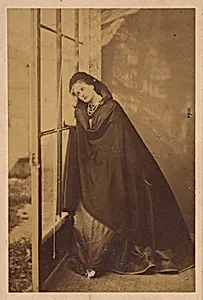
Medium
Albumen silver print from glass negative
Classification
Photographs
Department
Photographs
Museum
Metropolitan Museum of Art, New York, NY
Credit
David Hunter McAlpin Fund, 1975
Accession Number
1975.548.43
Rights
Public Domain
Tags
Art Historical Context
**Beatrice**, a captivating albumen silver print from a glass negative by Pierre-Louis Pierson, dates to the 1860s and resides in the Metropolitan Museum of's Photographs Department. This portrait exemplifies the elegance of Second Empire France, where photography emerged as a vital medium for capturing the sophistication of high society. Pierson, skilled French photographer, specialized in intimate portraits of women, rendering Beatrice with a poised grace that reflects the era's fascination with femininity and refinement. The albumen silver process, dominant from the 1850s to 1890s, produced richly toned images with exceptional detail, thanks to its use of egg whites to bind light-sensitive silver salts onto paper from sharp glass negatives. This technique allowed for the subtle nuances in fabric textures and facial expressions that make *Beatrice* so lifelike, bridging photography's documentary roots with artistic portraiture. As a woman's portrait, the photograph highlights the cultural role of such images in 19th-century Europe—commemorating personal identity amid rapid social change. Acquired through the David Hunter McAlpin Fund in 1975, it invites visitors to appreciate how Pierson's work preserved fleeting moments of beauty for posterity.
About the Artist
Pierre-Louis Pierson · 1822–1913
Pierre-Louis Pierson (1822–1913) was a pioneering French portrait photographer whose career spanned the formative years of the medium. Born on December 13, 1822, in Hinckange in the Moselle department, Pierson developed an early fascination with photography during the 1840s, as the daguerreotype was still in its infancy. His early life and formal training remain sparsely documented, but by 1844, h...