
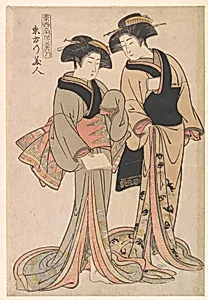
Beauties of the East
ca. 1782
Medium
Woodblock print; ink and color on paper
Dimensions
14 11/16 x 10 in. (37.3 x 25.4 cm)
Classification
Prints
Culture & Period
Japan · Edo period (1615–1868)
Department
Asian Art
Museum
Metropolitan Museum of Art, New York, NY
Credit
Rogers Fund, 1914
Accession Number
JP194
Rights
Public Domain
Tags
Art Historical Context
Kitao Shigemasa's *Beauties of the East* (ca. 1782) is a captivating woodblock print from Japan's Edo period (1615–1868), showcasing the artist's mastery in *bijin-ga*, or images of beautiful women. This vibrant ink and color on paper work, measuring 14 11/16 x 10 inches, depicts elegant female figures embodying the refined aesthetics of urban life in 18th-century Japan. Shigemasa, a leading ukiyo-e ("pictures of the floating world") artist, was renowned for his delicate portrayals of courtesans and everyday beauties, blending realism with idealized grace. Woodblock printing, the medium's hallmark, allowed for affordable mass production, democratizing art during the prosperous Edo era. Techniques like *nishiki-e* (brocade prints) layered multiple color blocks for rich hues and subtle gradients, evident in the kimonos' intricate patterns and soft skin tones here. This innovation made such prints cultural treasures, reflecting fashion, hairstyles, and social mores of the time. Acquired through the Rogers Fund in 1914, this piece from the Metropolitan Museum of Art's Asian Art collection highlights Japan's artistic golden age, inviting visitors to appreciate how everyday beauty was elevated to timeless poetry.
About the Artist
Kitao Shigemasa · 1739–1820
Kitao Shigemasa (1739–1820), born in the bustling Nihonbashi district of Edo (modern Tokyo), emerged as a pivotal figure in ukiyo-e woodblock printing during Japan's Edo period. The eldest son of the bookseller Suharaya Mohei—from a lineage of publishers—Shigemasa, originally named Kitabatake Tarōkichi, was immersed in the world of printing from youth. Largely self-taught, he later studied under t...