
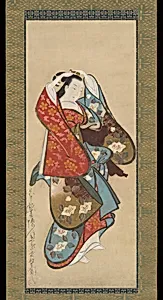
Beautiful Woman
18th century
Medium
Hanging scroll; ink and color on paper
Dimensions
Image: 32 3/16 x 13 3/16 in. (81.8 x 33.5 cm) Overall with mounting: 64 3/8 x 20 1/8 in. (163.5 x 51.1 cm)
Classification
Paintings
Culture & Period
Japan · Edo period (1615–1868)
Department
Asian Art
Museum
Metropolitan Museum of Art, New York, NY
Credit
The Harry G. C. Packard Collection of Asian Art, Gift of Harry G. C. Packard, and Purchase, Fletcher, Rogers, Harris Brisbane Dick, and Louis V. Bell Funds, Joseph Pulitzer Bequest, and The Annenberg Fund Inc. Gift, 1975
Accession Number
1975.268.125
Rights
Public Domain
Tags
Art Historical Context
"Beautiful Woman" is a captivating hanging scroll by Kaigetsudō Dohan, a master of early 18th-century Kaigetsudō school Japan's Edo period (1615–1868). Created with ink and color on paper this work measures 32 3/16 x 13 3/16 inches and exemplifies bijin-ga, or "pictures of beautiful women," a genre celebrating feminine grace and allure amid the era's booming urban culture in cities like Edo (modern Tokyo). Dohan's style stands out for its, voluptuous figures with flowing robes and expressive poses, rendered in vibrant pigments and fluid ink lines that evoke sensuality and elegance. Hanging scrolls like this were prized possessions in merchant homes, unrolled for intimate viewing during tea gatherings or seasonal displays, blending art with everyday refinement. The Kaigetsudō school's influence rippled through ukiyo-e woodblock prints, bridging painting and mass-produced imagery. Housed in the Metropolitan Museum of Art's Asian Art Department as part of The Harry G. C. Packard Collection, this piece offers a window into Edo Japan's fascination with beauty, pleasure quarters, and the floating world of fleeting joys.