
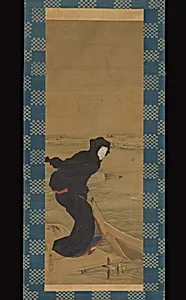
Beauty on a Snowy Quay
18th century
Medium
Hanging scroll; ink and color, and gold on silk
Dimensions
29 x 10 3/4 in. (73.7 x 27.3 cm)
Classification
Paintings
Culture & Period
Japan · Edo period (1615–1868)
Department
Asian Art
Museum
Metropolitan Museum of Art, New York, NY
Credit
Charles Stewart Smith Collection, Gift of Mrs. Charles Stewart Smith, Charles Stewart Smith Jr., and Howard Caswell Smith, in memory of Charles Stewart Smith, 1914
Accession Number
14.76.55
Rights
Public Domain
Tags
Art Historical Context
**Beauty on a Snowy Quay by Teisai Hok captures the ethereal grace of a woman poised on a snow-dusted quay during Japan's Edo period (161–1868). Created in the 18th century, this scroll exemplifies ukiyo-e, the "pictures of the floating world style that celebrated fleeting beauty and everyday elegance amid urban life in Edo (modern Tokyo). Hokuba a pupil of the renowned Katsushika Hokusai, skillfully blended delicate realism with poetic serenity, portraying feminine allure against a stark winter landscape. Rendered in ink, color, and gold on silk—measuring 29 x 10¾ inches—this intimate vertical format was designed for private display in homes, allowing viewers to unroll and savor its luminous details. The gold flecks evoke shimmering snow and opulent light, a technique highlighting silk's smooth absorbency for vibrant, layered hues. Such bijin-ga (pictures of beautiful women) reflected the era's fascination with courtesans and refined ladies, symbolizing transience in a prosperous, peaceful time. Housed in the Metropolitan Museum of Art's Asian Art collection, this piece from the Charles Stewart Smith Collection invites us to ponder beauty's quiet resilience in nature's chill embrace—a timeless Edo gem.
About the Artist
Teisai Hokuba · 1771–1844
Teisai Hokuba (1771–1844) was a Japanese artist of the Edo period who worked in the tradition of ukiyo-e, the celebrated school of woodblock prints and paintings that depicted the floating world of urban pleasure, theater, landscape, and daily life. A devoted pupil of Katsushika Hokusai — one of the towering figures in the history of Japanese art — Hokuba adopted the prefix of his master's name as...