
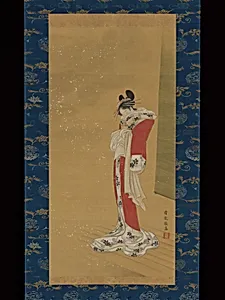
雪中縁先美人図|Beauty on a Veranda in Snow
ca. 1794–95
Medium
Hanging scroll; ink and color on silk
Dimensions
Image: 29 1/8 × 12 3/16 in. (74 × 31 cm) Overall with knobs: 57 7/8 × 19 1/8 in. (147 × 48.5 cm) Overall with mounting: 57 7/8 × 17 3/16 in. (147 × 43.7 cm)
Classification
Paintings
Culture & Period
Japan · Edo period (1615–1868)
Department
Asian Art
Museum
Metropolitan Museum of Art, New York, NY
Credit
Fishbein-Bender Collection, Gift of T. Richard Fishbein and Estelle P. Bender, in celebration of the Museum’s 150th Anniversary, 2020
Accession Number
2020.393.2
Rights
Public Domain
Tags
Art Historical Context
**Beauty on a Veranda in** (雪中縁先美人), created by Sakai Hōitsu 1794–95, captures a serene moment of feminine grace amid winter's hush. This hanging scroll, in ink and color on silk, exemplifies Edo-period (1615–1868) Japanese painting traditions. Hōitsu, a master of the Rinpa, blended delicate realism with decorative flair, drawing from earlier artists like Ogata Kōrin to revive opulent, nature-infused aesthetics in the late 18th century. The luxurious silk medium allowed for vibrant hues and subtle gradations, perfect for intimate display in a tokonoma alcove. At 29 1/8 × 12 3/16 inches, the image portrays a bijin—or beautiful woman—poised elegantly on a snow-dusted veranda, her kimono flowing softly against the stark landscape. Snowflakes and bare branches evoke seasonal poetry (wabi-sabi impermanence), a cultural motif celebrating beauty in transience. Hanging scrolls like this were cherished heirlooms, unrolled for special occasions to inspire contemplation. Hōitsu's work bridges ukiyo-e vibrancy and classical yamato-e lyricism, influencing later Japanese art. Now in the Metropolitan Museum of Art's Asian Art collection (Fishbein-Bender gift, 2020), it invites visitors to savor Japan's refined harmony of figure, season, and silk. (198 words)
About the Artist
Sakai Hōitsu 酒井抱一 (Japanese) · 1761 –1828
Japanese, 1761–1828