
Bed Cover (Palampore)
Unknown Artist
18th century
Medium
Cotton; plain weave, mordant painted and dyed, resist-dyed
Dimensions
Textile: H. 107 in. (271.8 cm) W. 77 3/4 in. (197.5 cm) Mount: H. 117 1/2 in. (298.5 cm) W. 86 5/8 in. (220 cm) D. 2in. (5.1 cm)
Classification
Textiles-Painted and/or Printed
Department
Islamic Art
Museum
Metropolitan Museum of Art, New York, NY
Credit
Purchase, Bequest of George Blumenthal and Gift of Indjoudjian Freres, by exchange, and The Friends of the Islamic Department Fund, 1982
Accession Number
1982.66
Rights
Public Domain
Tags
Art Historical Context
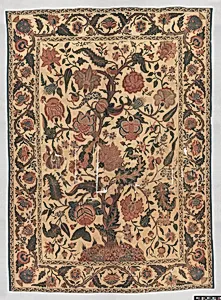
This stunning 18th-century Bed Cover, known as a *palampore*, is a masterful example of cotton textile artistry from the Islamic world, likely produced in India for export. Measuring over 8 feet tall and 6 feet wide, it designed as a luxurious bedspread, transforming ordinary sleeping spaces into vibrant displays of nature's abundance. Its floral motifs—ident in the tagged "Flowers" theme—reflect the era's fascination with botanical splendor, drawing from Indo-Islamic traditions where gardens symbolized paradise. Crafted on plain-weave cotton, the palampore employs sophisticated mordant painting and resist-dyeing techniques. Mordants fixed vibrant dyes to the fabric, while resist methods (like wax or clay) created crisp patterns by blocking color in select areas, yielding the luminous reds, blues, and greens typical of Coromandel Coast chintz. These labor-intensive processes, perfected over generations, highlight the technical prowess of anonymous artisans and fueled global trade, adorning European and American homes. Housed in the Metropolitan Museum of Art's Islamic Art Department, this piece (acquired in 1982) underscores the cultural exchange of the 18th century, blending artistry with everyday elegance. Visitors will appreciate its scale and vividness, a window into a world where textiles wove stories of beauty and craftsmanship.