
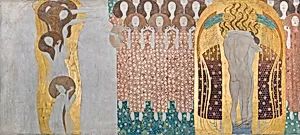
Beethovenfries: Die Künste, Paradieschor und Umarmung - Tafel 8, rechte Langwand
1901/1902
Medium
Kaseinfarben, Stuckauflagen, Zeichenstift, Applikationen aus verschiedenen Materialien (Glas, Perlmutt etc.), Goldauflagen auf Mörtel
Dimensions
215 x 481 cm
Classification
Wandbild
Department
Belvedere Collection
Museum
Belvedere
Credit
Belvedere, Vienna
Accession Number
5987/8
Rights
Public Domain
About this artwork
Nach einem leeren Wandfeld, das nicht erhalten geblieben ist, folgen die Figuren der "Künste". Sie führen in das "Ideale Reich", in dem allein reine Freude, reines Glück und reine Liebe existieren. Diese wird symbolisiert durch die Umarmung vor dem Paradieschor: "Freude schöner Götterfunke. Diesen Kuss der ganzen Welt!"
Art Historical Context
In the heart of Vienna's Secessionist movement, Gustav Klimt created his monumental *Beethoven Frieze* in 1901–1902 for the 14th Secession Exhibition, a bold tribute to Beethoven's Ninth Symphony. This, *Die Künste, Paradieschor und Umarmung* (The Arts, Paradise Choir, and Embrace)—Panel 8 on the right long wall—spans an impressive 215 x 481 cm. It transitions viewers from earthly struggles into an "Ideal Realm" of pure joy, happiness, and love, following a now-lost empty wall field. The flowing figures of the Arts guide the way, embodying Klimt's dreamlike symbolism and Art Nouveau elegance. At the center, a tender embrace before the ethereal Paradise Choir evokes Schiller's *Ode to Joy*: "Freude schöner Götterfunke. Diesen Kuss der ganzen Welt!" (Joy, beautiful spark of the gods. This kiss for the whole world!). This climactic moment celebrates universal harmony, reflecting fin-de-siècle yearnings for transcendence amid social upheaval. Klimt's revolutionary technique—casein paints, stucco reliefs, ink drawings, and lavish applications of gold, glass, mother-of-pearl, and more on mortar—creates a shimmering, jewel-like surface. Housed in Vienna's Belvedere Collection, this wall painting exemplifies Klimt's fusion of ornamentation and emotion, influencing modernist decoration and remaining a pinnacle of Viennese Symbolism.
About the Artist
Gustav Klimt · 1862–1918
Gustav Klimt was born on July 14, 1862, in Baumgarten near Vienna, the second of seven children in a modest family of artistic bent. His father, Ernst Klimt, a gold engraver who had immigrated from Bohemia, and his mother, Anna Finster, an aspiring musician, instilled an early appreciation for craft and creativity amid financial hardship. Klimt displayed prodigious drawing talent, prompting his en...