
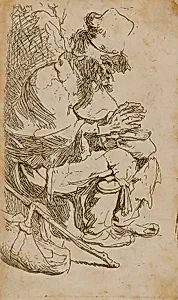
Beggar Warming His Hands
Medium
Graphic Arts-Print
Classification
Graphic Arts-Print
Department
Smithsonian Collection
Museum
Smithsonian American Art Museum
Credit
Smithsonian American Art Museum, Gift of Mrs. Robert J. Service
Accession Number
1966.6.3
Rights
Public Domain
Tags
Art Historical Context
In the hallowed halls of the Smithsonian American Art, Rembrandt van Rijn's *Beggar Warming His Hands captures the raw humanity of 17th-century Dutch life. Created as an undated etching—a graphic arts print—this work exemplifies Rembrandt's mastery during the Dutch Golden Age, a period of prosperity shadowed by stark social divides. Donated by Mrs. Robert J. Service it now resides in the Smithsonian Collection, inviting visitors to ponder the artist's empathy for society's margins. The full-length figure of the beggar, huddled against the cold with hands outstretched and a weathered hat atop his head, embodies themes of poverty that Rembrandt explored throughout his career. Unlike grand historical scenes, this intimate portrait highlights everyday struggle, rendered with meticulous detail in line and texture. Rembrandt's etchings, produced using acid on copper plates, allowed for rich tonal contrasts akin to his oil paintings' chiaroscuro—deep shadows enveloping the figure, drawing the eye to his desperate warmth-seeking gesture. This print's cultural resonance lies in its accessibility; etchings were relatively affordable, democratizing art for a broader audience. It reflects Baroque sensitivity to light, emotion, and the human condition, reminding us that even amid opulence, vulnerability persists—a timeless lesson from one of history's greatest printmakers.