
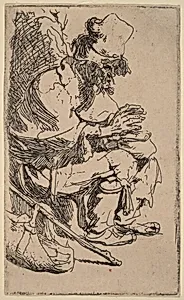
Beggar Seated Warming His Hands at a Chafing Dish
c. 1630
Medium
etching
Classification
Department
CG-E
Museum
National Gallery of Art, Washington, D.C.
Credit
Rosenwald Collection
Accession Number
1943.3.7072
Rights
Public Domain
Art Historical Context
In the early 1630s, as Rembrandt van Rijn was establishing as a leading artist in the Dutch Golden Age, he created *Beggar Seated Warming His at a Chafing*, a poignant etching that captures the quiet dignity of everyday struggle. Dated around 1630, this print reflects Rembrandt's fascination with ordinary people, particularly the marginalized, at a time when Leiden and Amsterdam were bustling centers of trade and innovation amid economic disparity. Rembrandt's mastery of etching shines here: he incised fine lines into a copper plate with acid, then enriched them with drypoint burrs for velvety textures and dramatic contrasts of light and shadow—hallmarks of his Baroque style influenced by Caravaggio. The beggar huddles over a glowing chafing dish, its warm light piercing the surrounding darkness, symbolizing fleeting comfort amid hardship. This intimate scale (about 5 x 4 inches) allowed etchings like this to be affordable and widely shared, democratizing art. Housed in the National Gallery of Art's Rosenwald Collection (Department CG-E), this work exemplifies Rembrandt's empathy for the poor and his technical innovation in printmaking, producing over 300 etchings that influenced generations. It's a reminder of 17th-century Europe's social realities, inviting viewers to ponder humanity's shared vulnerabilities.
About the Artist
Rembrandt van Rijn · 1606–1669
Rembrandt Harmenszoon van Rijn (1606–1669) stands as one of the greatest visual artists in the history of Western art and the most important Dutch painter of the 17th century. Born in Leiden to a prosperous miller's family, Rembrandt transformed painting through his revolutionary use of light and shadow, his psychological depth in portraiture, and his elevation of etching to a fine art. His approx...