
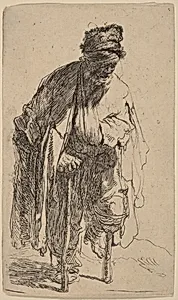
Beggar with a Wooden Leg
c. 1630
Medium
etching
Dimensions
sheet (trimmed to plate mark): 11.5 x 6.8 cm (4 1/2 x 2 11/16 in.)
Classification
Department
CG-E
Museum
National Gallery of Art, Washington, D.C.
Credit
Rosenwald Collection
Accession Number
1946.21.158
Rights
Public Domain
Art Historical Context
In the early 1630s, Rembrandt van Rijn, Dutch Baroque master renowned for his dramatic use of light and shadow (chiaroscuro), created *Beggar with a Wooden Leg*, a poignant etching that captures the hardships of everyday life. Produced around 1630, this small (just 11.5 x 6.8 cm) reflects Rembrandt's fascination with the human condition, particularly the marginalized figures of 17th-century Dutch society. Beggars like this one were common sights in Leiden and Amsterdam, where Rembrandt lived and worked, symbolizing resilience amid poverty and often evoking empathy through his empathetic gaze. Etching allowed Rembrandt to achieve extraordinary detail and tonal depth with acid-bitten lines on a copper plate, a technique he perfected to rival the richness of his paintings. Here, the beggar's weathered face, crutch, and tattered clothes emerge with remarkable realism and emotional intensity, showcasing his innovative drypoint additions for velvety textures. This intimate scale invites close viewing, much like a whispered story from the streets. Housed in the National Gallery of Art's Rosenwald Collection, this work exemplifies Rembrandt's early printmaking genius, bridging genre scenes and portraiture. It reminds us of his humanistic touch, transforming a humble beggar into a dignified subject worthy of artistic immortality.
About the Artist
Rembrandt van Rijn · 1606–1669
Rembrandt Harmenszoon van Rijn (1606–1669) stands as one of the greatest visual artists in the history of Western art and the most important Dutch painter of the 17th century. Born in Leiden to a prosperous miller's family, Rembrandt transformed painting through his revolutionary use of light and shadow, his psychological depth in portraiture, and his elevation of etching to a fine art. His approx...