
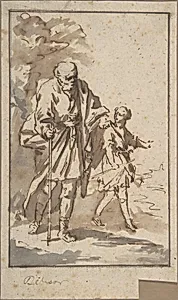
Belisarius
17th century
Medium
Pen and brown ink, brush and brown and gray wash. Framing lines in pen and brown ink, graphite.
Dimensions
6 9/16 x 3 7/8 in. (16.7 x 9.9 cm)
Classification
Drawings
Department
Drawings and Prints
Museum
Metropolitan Museum of Art, New York, NY
Credit
The Elisha Whittelsey Collection, The Elisha Whittelsey Fund, 1953
Accession Number
53.513.10
Rights
Public Domain
Tags
Art Historical Context
In the heart of the Metropolitan Museum of's Drawings and Prints department sits *Belisarius*, a 17th-century French drawing by an anonymous artist. Crafted with pen and brown ink, brush and and gray wash, plus subtle graphite framing lines, this sheet measures just 6 9/16 x 3 7/8 inches. Acquired through The Elisha Whittelsey Fund in 1953, it the refined draftsmanship of France's Baroque era, when artists drew inspiration from classical antiquity and dramatic historical tales. The title refers to Flavius Belisarius, the legendary 6th-century Byzantine general under Emperor Justinian I, whose triumphs reconquered vast territories for the empire. A popular motif in European art, Belisarius's story—blinded, beggared, and reduced to alms-seeking, yet nobly enduring—symbolized stoic virtue amid fortune's reversals. This drawing likely captures that iconic scene, featuring men and a girl (per its tags), evoking pathos through humble figures in a moment of human frailty and unrecognized greatness. The mixed-media technique shines here: precise ink lines define forms, while washes build shadowy depth and emotion, mimicking the tonal modeling of oil paintings. Such works were prized as independent studies, reflecting 17th-century France's fascination with history painting and moral allegory during Louis XIV's grandeur. A gem for visitors, it invites reflection on resilience across centuries.