
Belisarius Begging for Alms
mid-18th–early 19th century
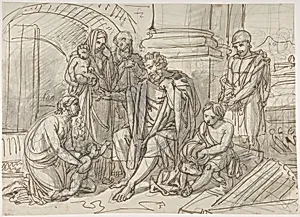
Medium
Pen and brown ink, brush and brown wash over black chalk, over graphite underdrawing
Dimensions
10 5/8 x 14 1/2 in. (27 x 36.8 cm)
Classification
Drawings
Department
Drawings and Prints
Museum
Metropolitan Museum of Art, New York, NY
Credit
Harris Brisbane Dick Fund, 1947
Accession Number
47.155.7
Rights
Public Domain
Tags
Art Historical Context
In the evocative drawing *Belisarius Begging Alms*, created by German Neoclassical artist Heinrich Friedrich Füger the mid-18th to early 19th century we witness a poignant moment from ancient legend. Füger, a prominent figure in Vienna's art scene and director of the of Fine Arts, captures the dramatic fall of Byzantine general Belisarius. Once a triumphant commander under Emperor Justinian I Belisarius was reportedly blinded, stripped of wealth, and reduced to begging on the streets—an enduring tale of fortune's fickleness popularized in Western art during the Neoclassical era, which revered classical history for its moral lessons. Rendered on a modest sheet measuring 10⅝ × 14½ inches, this preparatory study showcases Füger's mastery of mixed media: a graphite underdrawing laid the foundation, followed by black chalk for modeling, precise pen and brown ink lines for contours, and subtle brown wash for atmospheric depth. Such techniques, common in academic drawing practices, allowed artists to refine compositions before painting, emphasizing clarity, anatomy, and emotional narrative. Tags hint at a bustling scene with men, women, infants, and generals, likely depicting Belisarius unrecognized by his former servant amid everyday life. Housed in the Metropolitan Museum of Art's Drawings and Prints department (acquired via the Harris Brisbane Dick Fund in 1947), this work exemplifies Neoclassicism's blend of historical reverence and human pathos, inviting visitors to reflect on power's transience.