
Belisarius (Furnishing Fabric)
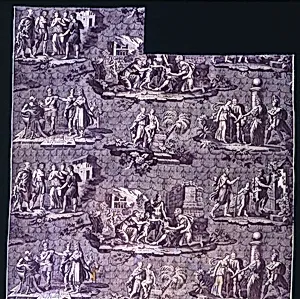
Medium
Cotton, plain weave; engraved roller printed
Dimensions
91.4 × 86.5 cm (36 × 34 in.)
Classification
textile
Department
Textiles
Museum
Art Institute of Chicago
Accession Number
13608
Rights
Public Domain
Art Historical Context
Step into the elegant world of 19th-century French textiles with *Belisarius (Furnishing Fabric)* designed by Jean-Louis-Touss Caron in 1821. This vibrant cotton piece, measuring 91.4 × 86.5 cm, captures a dramatic historical scene inspired by the Byzantine general Belisarius famed for his military triumphs under Emperor Justinian I and his tragic fall into blindness and poverty. Caron, a master of textiles from the Jouy-en-J tradition, infused the fabric with neoclassical storytelling, blending heroism and pathos to adorn homes during France's Restoration era. Crafted from plain-weave cotton using the innovative engraved roller printing technique, this work exemplifies early industrial artistry. Roller printing, a breakthrough around 1810, allowed for precise, repeatable patterns on a grand scale—revolutionizing furnishing fabrics like curtains and upholstery. No longer reserved for elites, such textiles brought sophisticated decoration to middle-class interiors, reflecting the era's growing fascination with history and antiquity. Housed in the Art Institute of Chicago's Textiles Department, *Belisarius* highlights how everyday objects became canvases for cultural narratives, bridging fine art and domestic life in post-Revolutionary France. A testament to Caron's skill, it invites us to appreciate the artistry woven into our surroundings.