
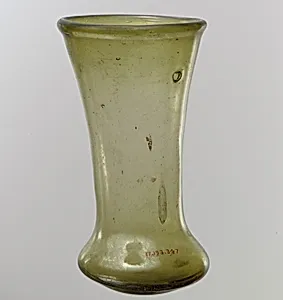
Bell Beaker
Unknown Artist
6th–7th century
Medium
Glass
Dimensions
Overall: 4 5/16 x 2 3/8 in. (11 x 6.1 cm)
Classification
Glass-Vessels
Culture
Frankish
Department
Medieval Art
Museum
Metropolitan Museum of Art, New York, NY
Credit
Gift of J. Pierpont Morgan, 1917
Accession Number
17.193.347
Rights
Public Domain
Art Historical Context
This delicate Bell Beaker, crafted by an unknown Frankish artisan in the 6th–7th century, exemplifies refined glassmaking traditions of early medieval Europe. Standing just 4 5/16 x 2 3/8 inches (11 x 6.1 cm), its bell-shaped form—wide at the mouth and tapering to a narrow base—suggests it was designed for drinking or pouring liquids, a common vessel type in daily life or ceremonial settings. Housed in the Metropolitan Museum of Art's Medieval Department, it entered the collection as a gift from J. Pierpont Morgan 1917, highlighting the era's crossover between industrial craft and artistic expression. Glass production flourished among the Franks, a Germanic people who dominated much of western Europe during the Merovingian period, blending Roman techniques with innovative local methods. Likely wheel-cut or trail-decorated, though details are subtle at this scale, the beaker reflects advanced technical skill: transparent or lightly colored glass required precise furnace control and annealing to achieve durability and clarity. Such vessels were prized possessions, often found in elite burials, symbolizing wealth and cultural continuity from late antiquity. Today, this modest yet masterful piece invites us to appreciate the unsung artistry of Frankish craftsmen, bridging the classical world and the Middle Ages. Its survival offers a tangible glimpse into a vibrant, transitional society.