
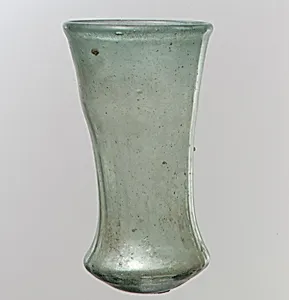
Glass Beaker
Unknown Artist
late 6th–early 7th century
Medium
Glass
Dimensions
Overall: 4 3/16 x 2 5/16 in. (10.6 x 5.9 cm)
Classification
Glass-Vessels
Culture
Frankish
Department
Medieval Art
Museum
Metropolitan Museum of Art, New York, NY
Credit
Gift of J. Pierpont Morgan, 1917
Accession Number
17.194.129
Rights
Public Domain
Art Historical Context
This delicate glass beaker, crafted by an unknown Frankish artisan in the late 6th to early 7th century, a glimpse into the everyday elegance of Merovingian Europe. Standing just over 4 inches tall and 2 inches wide, it exemplifies the modest yet refined vessels used for drinking or serving in Frankish households. Produced during the reign of the Merovingian kings—who ruled much of what is now France Germany—this beaker reflects a cultural bridge between the fading Roman world and the emerging medieval era, where glass objects symbolized status and hospitality. Frankish glassmakers inherited Roman techniques but adapted them with local innovation, likely molding or blowing the thin, translucent walls to achieve their subtle sheen. Though simple in form, such beakers were labor-intensive to produce, highlighting skilled craftsmanship amid a time of political upheaval and Christianization. Its survival underscores the durability of glass as both functional art and archaeological treasure. Generously gifted to the Metropolitan Museum of Art by J. Pierpont Morgan in 1917, this beaker now resides in the Medieval Art department, inviting visitors to ponder the lives of those who once held it—perhaps during a feast in a timber hall or a quiet family meal. A testament to Frankish ingenuity, it reminds us how ordinary objects can illuminate history.