
Bell
1935/1942
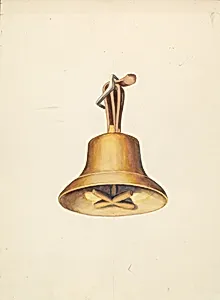
Medium
watercolor and graphite on paper
Dimensions
overall: 33 x 24.2 cm (13 x 9 1/2 in.) Original IAD Object: Buckle: 1 1/2" high; 1 1/4" wide; strap: 3/4" wide; Top of bell: 2 1/4" wide; bottom of bell4 3/4" wide; height of bell: 2 7/8"; clapper: 2 3/16" long; 7/16" thick
Classification
Index of American Design
Department
CG-W
Museum
National Gallery of Art, Washington, D.C.
Credit
Index of American Design
Accession Number
1943.8.8786
Rights
Public Domain
Art Historical Context
This vibrant watercolor and graphite rendering, titled *Bell* and created by an American artist between 1935 and 1942, captures the intricate details of a charming folk art object from the Index of American Design (IAD). Housed in the National Gallery of Art, the 33 x 24.2 cm sheet meticulously depicts a decorative buckle adorned with a bell: the buckle measures 1 1/2 inches high and 1 1/4 inches wide, paired with a 3/4-inch-wide strap; the bell flares from 2 1/4 inches at the top to 4 3/4 inches at the bottom, standing 2 7/8 inches tall, complete with a 2 3/16-inch-long clapper. Produced under the Federal Art Project of the Works Progress Administration (WPA) during the Great Depression, the IAD commissioned over 15,000 such precise, colorful studies to document and celebrate everyday American craftsmanship—from tools and textiles to whimsical accessories like this bell buckle. Watercolor allowed artists to evoke the object's metallic sheen and patina, while graphite added fine lines for anatomical accuracy, blending artistic skill with documentary precision. This piece highlights early American ingenuity in metalwork, evoking sleigh bells or horse tack from rural life. As part of the IAD's enduring legacy, it preserves cultural artifacts that might otherwise be lost, inviting us to appreciate the artistry in humble designs.
About the Artist
American 20th Century · 1900–1999
"American 20th Century" is the designation used by major institutions such as the National Gallery of Art (NGA) for anonymous and unidentified artists active in the United States during the twentieth century. The artist's personal identity, early life, and training remain undocumented, reflecting the challenges of attribution for unattributed works from this era. No specific teachers, art schools,...