
Belly-Amphora (Storage Jar)
550-540 BCE
Medium
terracotta, black-figure
Dimensions
28.2 × 21.6 × 19 cm (10 3/4 × 8 1/2 × 7 1/2 in.)
Classification
amphora
Department
Arts of Greece, Rome, and Byzantium
Museum
Art Institute of Chicago
Accession Number
52198
Rights
Public Domain
About this artwork
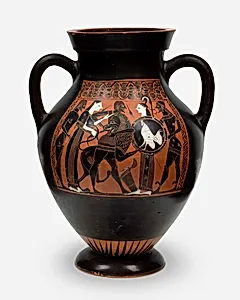
Ancient artists frequently depicted events from the life of the demigod Herakles, especially the Twelve Labors he had to complete to attain immortality. On this amphora (storage jar) the great hero completes his first assignment—to kill a lion with an invincible hide that was terrorizing the village of Nemea. Here the contest has been decided; Herakles strangles the lion, whose jaws he has pried open with his bare hands. To the right stand Athena and Hermes; on the other stand a nymph and Iolaos...
Art Historical Context
This elegant belly-amphora, created between 550 and 540 BCE by the Painter of Tarquinia RC 3984, exemplifies the refined black-figure technique of Archaic Greek pottery. Standing just over ten inches tall, the terracotta vessel features the characteristic rounded body and twin handles designed for storing and transporting wine or olive oil. Its attribution to this artist, named after a related vase now in Tarquinia, Italy, highlights the careful scholarship that connects individual hands across surviving examples from the period. In the black-figure method, the painter applied a glossy slip to create silhouetted figures against the natural red clay, then incised fine details with a sharp tool before firing. This labor-intensive process allowed for lively scenes of mythology or daily life, though the specific decoration on this amphora remains understated in scale. Such vessels played vital roles in both domestic symposia and funerary rituals, bridging practical function with artistic expression in ancient Greek society. Today housed in the Art Institute of Chicago’s collection of Greek, Roman, and Byzantine art, the amphora offers visitors a tangible connection to the vibrant ceramic traditions of sixth-century BCE Athens. Its modest size and balanced proportions reflect the high standards of craftsmanship that made black-figure pottery one of the most influential art forms of the ancient Mediterranean.