
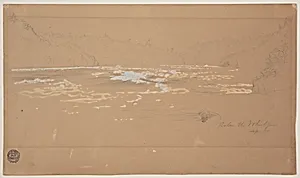
Below the Whirlpool, Niagara Falls, New York
September 1858
Classification
landscapes
Department
Smithsonian Collection
Museum
Smithsonian American Art Museum
Credit
Gift of Louis P. Church
Accession Number
1917-4-55-a
Rights
Public Domain
About this artwork
Research in Progress
Art Historical Context
Frederic Edwin Church, leading figure in the Hudson River School of landscape painting, captured the raw majesty of Niagara Falls in *Below the Whirlpool, Falls, New York*, during a visit in September 1858 This work depicts the turbulent waters just downstream from the infamous whirlpool rapids, a perilous spot that symbolized America's untamed natural power. Church, renowned for his meticulous studies of the American wilderness, made multiple expeditions to Niagara, sketching from precarious vantage points—including boats amid the churning currents—to achieve unparalleled realism and drama. As a quintessential Hudson River School landscape, the painting exemplifies Church's mastery in conveying the sublime: nature's awe-inspiring force that both humbles and elevates the viewer. Though the medium is unknown, Church's technique likely involved precise detailing of light, foam, and mist to evoke the falls' sensory intensity, blending scientific observation with romantic idealism. Niagara was a cultural icon in the 19th century, drawing tourists and artists alike as a testament to divine creation and national pride. Gifted to the Smithsonian American Art Museum by Louis P. Church, this piece invites us to ponder humanity's place amid nature's fury, much like Church's blockbuster *Niagara* (1857), which packed exhibition halls. Research continues, promising deeper insights into this vivid snapshot of a vanishing wild frontier.