
Belt Buckle
Unknown Artist
6th–7th century
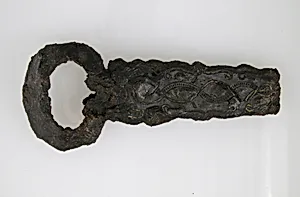
Medium
Iron, gold, silver and brass inlay
Dimensions
Overall: 4 x 1 5/8 x 1/2 in. (10.1 x 4.2 x 1.3 cm)
Classification
Metalwork-Iron
Culture
Frankish
Department
Medieval Art
Museum
Metropolitan Museum of Art, New York, NY
Credit
Gift of J. Pierpont Morgan, 1917
Accession Number
17.191.335
Rights
Public Domain
Art Historical Context
This exquisite Frankish belt buckle, dating to the 6th–7th century, exemplifies masterful metalwork of the early medieval Merovingian period. Crafted from iron with intricate inlays of gold, silver, brass, it measures a modest 4 x 1⅝ x ½ inches, yet its compact form belies its status as a prestige object. Likely worn by a member of the Frankish elite—perhaps a warrior or noble—this buckle would have secured a belt while signaling wealth and power through its shimmering materials. The technique of inlaying softer precious metals into a durable iron base highlights the sophisticated craftsmanship of Frankish artisans, who blended Roman influences with emerging Germanic styles. Such adornments were not mere accessories but symbols of social hierarchy in a time of transitioning kingdoms, following the fall of Rome and the rise of Clovis's Frankish realm. The use of contrasting metals created dynamic visual effects, catching light to emphasize motifs that may have held protective or status-related meanings. A generous gift from J. Pierpont Morgan in 1917, this buckle now graces the Medieval Art department at The Metropolitan Museum of Art, offering visitors a tangible link to the vibrant world of early medieval Europe.