
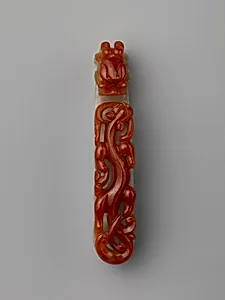
清中期 翡翠螭龍紋帶鉤|Belt hook with dragons
Unknown Artist
19th century
Medium
Jade (jadeite)
Dimensions
H. 3 11/16 in. (9.4 cm); W. 11/16 in. (1.7 cm); D. 1 in. (2.5 cm)
Classification
Jade
Culture & Period
China · Qing dynasty (1644–1911)
Department
Asian Art
Museum
Metropolitan Museum of Art, New York, NY
Credit
Gift of Heber R. Bishop, 1902
Accession Number
02.18.711
Rights
Public Domain
Tags
Art Historical Context
This exquisite belt hook, crafted from jadeite during China's Qing dynasty (1644–1) in the mid-19th century, exemplifies the era's mastery of jade carving. Measuring just 3⅝ inches high, it was designed as a functional accessory to secure belts, a tradition dating back over two millennia to the Warring States period Donated to the Metropolitan Museum of Art 1902 by Heber R. Bishop, this from the Asian Art collection highlights the Qing elite's passion for luxurious personal adornments. The artwork features intricate chi dragon motifs—mythical, benevolent creatures symbolizing imperial power, protection, and good fortune in Chinese culture. Carved from vibrant jadeite, prized for its translucency and durability, the hook showcases advanced techniques like incised detailing and smooth polishing, which allowed the stone's natural luster to shine. Such objects were status symbols for scholars and officials, blending utility with artistry. In Qing society, jade artifacts like this belt hook embodied Confucian virtues of purity and harmony. Its compact form made it ideal for everyday wear, yet its dragons evoked the emperor's divine authority, underscoring jade's enduring role in Chinese cosmology and connoisseurship.