
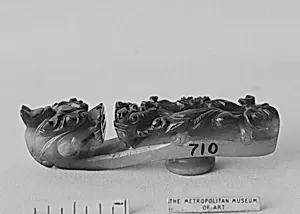
清晚期 螭紋翡翠帶鈎|Garment hook with feline motif
Unknown Artist
19th century
Medium
Jade (jadeite)
Dimensions
H. 2 5/8 in. (6.7 cm); W. 5/8 in. (1.6 cm); D. 11/16 in. (1.7 cm)
Classification
Jade
Culture & Period
China · Qing dynasty (1644–1911)
Department
Asian Art
Museum
Metropolitan Museum of Art, New York, NY
Credit
Gift of Heber R. Bishop, 1902
Accession Number
02.18.710
Rights
Public Domain
Art Historical Context
This delicate garment hook, crafted in the late Qing dynasty (19 century), exemplifies the pinnacle of Chinese jade carving. Made from prized jadeite—a vivid green variety sourced from Myanmar—this small accessory (just 2 5/8 inches high) served a practical purpose: fastening the sashes of traditional robes. Its compact form belies its status as a luxury item, often worn by elites to display wealth and refinement during the Qing era (1644–1911), when jade symbolized purity, immortality, and imperial virtue. The hook's surface is masterfully incised with a dynamic chi motif—a mythical, feline-like dragon without horns, evoking power and auspicious protection in Chinese lore. Qing artisans employed fine tools to render the creature's sinuous body, arched back, and fierce expression, highlighting the stone's translucency and polish. Such techniques, honed in imperial workshops, transformed functional objects into sculptural gems. Now in the Metropolitan Museum of Art's Asian Art collection (gift of Heber R. Bishop, 1902), this piece offers a glimpse into everyday elegance of late imperial China, where artistry elevated the mundane.