
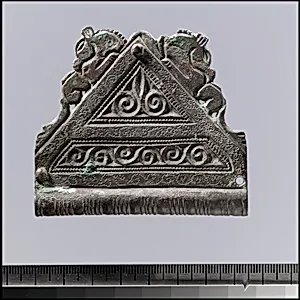
Belt Mount
Unknown Artist
late 4th–early 5th century
Medium
Copper alloy
Dimensions
Overall: 2 15/16 x 2 5/8 x 5/16 in. (7.4 x 6.6 x 0.8 cm)
Classification
Metalwork-Bronze
Culture
Late Roman
Department
Medieval Art
Museum
Metropolitan Museum of Art, New York, NY
Credit
Rogers Fund, 1957
Accession Number
57.161.2
Rights
Public Domain
Art Historical Context
This delicate belt mount, from copper alloy in the 4th to early 5th century, exemplifies the refined metalwork of Late Roman culture. Measuring just under 3 inches across, this small yet intricate accessory would have adorned a belt, serving both functional and decorative purposes. through the Rogers Fund in 7 and now housed in the Metropolitan Museum of's Medieval Art Department, it highlights the transition from classical antiquity to the early medieval world. In the waning years of the Roman Empire, such mounts were status symbols, often worn by soldiers, officials, or elites to signify rank and wealth. The use of copper alloy—a durable, affordable alternative to precious metals—allowed for widespread production through techniques like casting and chasing, preserving intricate details despite everyday wear. This piece reflects the empire's enduring craftsmanship amid political upheaval, as Roman artistic traditions influenced emerging barbarian styles. Visitors will appreciate how this unassuming object bridges eras, offering a tangible glimpse into daily life during Rome's twilight. Its survival speaks to the skill of ancient artisans and the allure of personal adornment that persists today.