
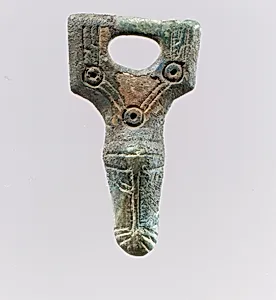
Belt Ornament (?)
Unknown Artist
middle of 6th century
Medium
Copper alloy
Dimensions
Overall: 1 7/8 x 1 x 7/16 in. (4.7 x 2.6 x 1.1 cm)
Classification
Metalwork-Copper alloy
Culture
Frankish
Department
Medieval Art
Museum
Metropolitan Museum of Art, New York, NY
Credit
Gift of J. Pierpont Morgan, 1917
Accession Number
17.193.280
Rights
Public Domain
Art Historical Context
This delicate belt ornament, crafted by an unknown Frankish artisan in the mid-6th century, a glimpse into the daily life and craftsmanship of the early Merovingian period. Hailing from the Frankish culture that dominated much of western Europe after the fall of Rome, such small metal fittings adorned belts worn by both men and women, serving practical purposes while signaling social status. Its modest dimensions—about 1 7/8 by 1 inches—belie its role as a personal accessory, possibly part of a warrior's or noble's ensemble. Forged from copper alloy, a durable and accessible medium for the era's metalworkers, the piece exemplifies the technical skill of Frankish smiths who cast and hammered alloys into intricate forms. Copper alloys were prized for their workability and corrosion resistance, making them ideal for jewelry and ornaments that endured burials and daily use. Though details of its decoration remain subtle, it reflects the transition from late Roman influences to emerging Germanic styles in medieval metalwork. Now housed in the Metropolitan Museum of Art's Medieval Art department, this artifact was generously gifted by J. Pierpont Morgan in 1917. For visitors, it evokes the vibrant world of the Franks, whose innovations laid the foundations for medieval European artistry.