
Belt Ornament (?)
Unknown Artist
middle of 6th century
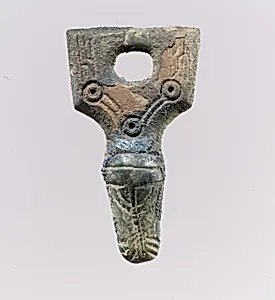
Medium
Copper alloy
Dimensions
Overall: 1 7/8 x 1 x 1/2 in. (4.7 x 2.5 x 1.2 cm)
Classification
Metalwork-Copper alloy
Culture
Frankish
Department
Medieval Art
Museum
Metropolitan Museum of Art, New York, NY
Credit
Gift of J. Pierpont Morgan, 1917
Accession Number
17.193.281
Rights
Public Domain
Art Historical Context
This delicate belt ornament, crafted in the mid-6th century by unknown Frankish artisan, the fine metalwork of the early Merovingian period. from copper alloy—a durable and accessible material for the era—this small piece (just under 2 inches wide) likely adorned a belt, serving both practical and decorative purposes. In Frankish society, which dominated much of post-Roman Gaul (modern-day France and Germany), such accessories were status symbols for warriors and elites, blending Germanic traditions with lingering Roman influences. The ornament's intricate form highlights the skilled techniques of Frankish metalworkers, who often cast, hammered, and engraved alloys to create portable luxury items. Though its exact design details are subtle due to its size, it reflects a time of cultural transition: the Franks, under kings like Clovis, were forging a new Christianized kingdom amid the fall of the Western Roman Empire. Belts and their ornaments signified wealth, identity, and readiness for battle. Generously gifted to the Metropolitan Museum of Art by J. Pierpont Morgan in 1917, this artifact offers a tangible glimpse into daily life 1,500 years ago, bridging the gap between antiquity and the medieval world.