
Belt Plate
Unknown Artist
7th century
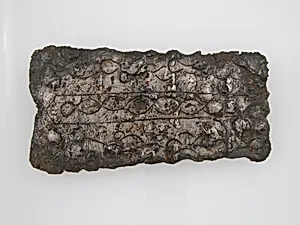
Medium
Iron, silver inlay
Dimensions
Overall: 4 3/16 x 2 1/4 x 1/4 in. (10.7 x 5.7 x 0.6 cm)
Classification
Metalwork-Iron
Culture
Frankish or Burgundian
Department
Medieval Art
Museum
Metropolitan Museum of Art, New York, NY
Credit
Gift of J. Pierpont Morgan, 1917
Accession Number
17.191.340
Rights
Public Domain
Art Historical Context
This exquisite 7th-century belt, crafted from iron with delicate silver inlay, offers a glimpse into the material culture of the Frankish or Burgundian in early medieval Europe. Measuring just 4 3/16 x 2 1/4 inches, this small yet striking piece from the Metropolitan Museum of Art's Medieval Art collection a functional accessory—likely part of a warrior's or noble's belt—highlighting everyday luxury amid the post-Roman world. Dating to the Merovingian era when Frankish kingdoms dominated much of western Europe, such metalwork reflects the fusion of Germanic traditions and Roman influences. Belt plates like this were status symbols, worn by elites to display wealth and craftsmanship during a time of migration, conquest, and Christianization. The silver inlay technique, where fine silver wires or sheets were hammered into incised iron, demonstrates sophisticated metallurgical skills passed down through workshops, blending durability with ornamentation. Today, this artifact—generously gifted to the Met by J. Pierpont Morgan in 1917—invites us to ponder the lives of its long-ago owners, bridging the gap between ancient utility and timeless artistry.