
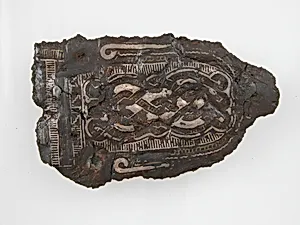
Counter Plate of a Belt Buckle
Unknown Artist
7th century
Medium
Iron, silver and brass inlay
Dimensions
Overall: 4 1/8 x 2 9/16 x 7/16 in. (10.4 x 6.5 x 1.1 cm)
Classification
Metalwork-Iron
Culture
Frankish
Department
Medieval Art
Museum
Metropolitan Museum of Art, New York, NY
Credit
Gift of J. Pierpont Morgan, 1917
Accession Number
17.193.193
Rights
Public Domain
Art Historical Context
Step into the world of 7th-century Frankish with this exquisite *Counter Plate of a Belt Buckle*, a testament to the skilled metalworkers of the Merovingian. Crafted from iron with intricate silver and brass inlays this small yet striking piece (measuring just 4 1/8 x 2 9/16 x 7/16 inches) served as part of a belt buckle, likely adorning the attire of a warrior or noble. The Franks, a Germanic people who dominated much of Western Europe after the fall of Rome, valued such accessories as symbols of status and identity, blending utilitarian function with decorative flair. The artistry shines in its inlay technique, where silver and brass were meticulously embedded into the iron base, creating contrasting patterns that caught the light and highlighted the wearer's prestige. This metalwork exemplifies early medieval innovation, bridging Roman traditions with emerging barbarian styles, and reflects the Frankish mastery of alloys and niello-like methods for durability and shine. A generous gift from J. Pierpont Morgan in 1917, this artifact now graces the Medieval Art collection at The Metropolitan Museum of Art, offering visitors a tangible link to the daily lives and craftsmanship of Frankish society over 1,300 years ago.