
Belt Plate Fragment
Unknown Artist
500–700
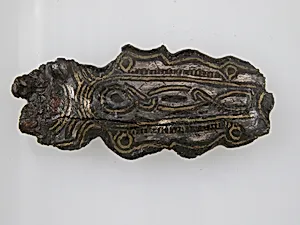
Medium
Iron, silver and brass inlay
Dimensions
Overall: 2 7/8 x 1 1/4 x 3/16 in. (7.3 x 3.2 x 0.5 cm)
Classification
Metalwork-Iron
Culture
Frankish
Department
Medieval Art
Museum
Metropolitan Museum of Art, New York, NY
Credit
Gift of J. Pierpont Morgan, 1917
Accession Number
17.191.117
Rights
Public Domain
Art Historical Context
This exquisite Belt Plate Fragment, dating to the Frankish period between 500 and 700 CE, offers a tantalizing glimpse into the world of early medieval Europe. Crafted by an unknown artisan from the Frankish culture—likely the Merovingian dynasty that dominated Gaul (modern-day France and surrounding regions)—this small iron piece (just 2 7/8 x 1 1/4 inches) once adorned a belt, a key accessory for warriors and elites symbolizing status and readiness for battle. The artwork's standout feature is its sophisticated metalwork: a sturdy iron base enhanced with intricate silver and brass inlays. This technique, known as damascening or inlay work, involved cutting channels into the iron and hammering in contrasting precious metals, creating shimmering patterns that caught the light. Such embellishments were labor-intensive, reserved for high-quality personal gear, and reflect the Franks' mastery of blending Roman metalworking traditions with Germanic motifs during the transition from late antiquity to the Middle Ages. Now housed in the Metropolitan Museum of Art's Medieval Art Department, thanks to a 1917 gift from J. Pierpont Morgan, this fragment survives as a testament to everyday luxury among Frankish nobility. Though incomplete, it evokes the clink of belts in a chieftain's hall, reminding us how even humble objects carried profound cultural weight.