
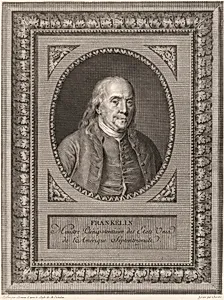
Benjamin Franklin
c. 1778-85
Medium
Classification
Department
Smithsonian Collection
Museum
Smithsonian American Art Museum
Credit
National Portrait Gallery, Smithsonian Institution
Accession Number
NPG.96.106
Rights
Public Domain
Tags
Art Historical Context
This elegant print portrait of Benjamin Franklin, created by French engraver Justus Chev around 1778–85, captures the polymath statesman during his pivotal diplomatic years in France. Chevillet, renowned for his precise line work in 18th-century portrait engravings, frames Franklin within an ornate cartouche—an decorative architectural motif often used in prints to evoke classical grandeur and lend portraits a sense of timeless importance. Housed in the Smithsonian American Art Museum's, this work exemplifies the era's reproductive printmaking, which allowed images of celebrated figures to circulate widely across Europe and America. Franklin, depicted in a contemplative interior setting, embodies the Enlightenment ideal: inventor, scientist, writer, printer, diplomat, and signer of the Declaration of Independence. By the late 1770s, as America's ambassador to France, he helped secure vital alliances and the 1783 Treaty of Paris, ending the Revolutionary War. Chevillet's meticulous engraving technique highlights Franklin's bifocals and fur cap—symbols of his ingenuity and rustic American persona—making this print not just a likeness, but a cultural icon that popularized his fame. As a testament to transatlantic exchange, the portrait underscores prints' role in shaping public identity during the birth of the United States, blending artistry with political propaganda in an accessible medium.