
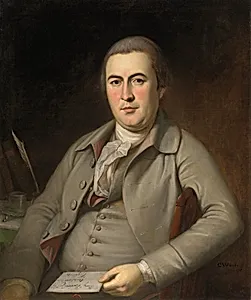
Benjamin Harrison, Jr.
Medium
Painting
Classification
Painting
Department
Smithsonian Collection
Museum
Smithsonian American Art Museum
Credit
National Portrait Gallery, Smithsonian Institution; transfer from the National Gallery of Art; gift of the A.W. Mellon Educational and Charitable Trust, 1942
Accession Number
S/NPG.65.109
Rights
Public Domain
Tags
Art Historical Context
Step into the world of early American portraiture with *Benjamin Harrison, Jr.* (1783), a compelling oil painting by Charles Willson Peale, one of the nation's foremost artists of the Revolutionary era. Peale, for his precise, lifelike depictions of Founding Fathers and patriots, captures Harrison seated in an elegant interior, surrounded by symbols of intellect and diplomacy: a table with inkstand, quill, open book, and envelope. props evoke the scholarly pursuits and correspondence that defined elite life post-Revolution. Painted in 1783—just as the Treaty of Paris ended the War for Independence—this portrait honors Benjamin Harrison, Jr., a key Revolutionary figure and signer of the Declaration of Independence. As a Virginia statesman and governor, Harrison embodied the Enlightenment ideals of liberty and governance, and Peale's naturalistic style highlights his dignified poise, using soft lighting and meticulous detail to convey authority and introspection. Housed in the Smithsonian American Art Museum, this work exemplifies Peale's role in forging a visual identity for the new republic, blending European portrait traditions with American optimism. A must-see for history buffs, it reminds us how art immortalized the builders of a nation.