
Berthe
January 22, 1862–April 1862
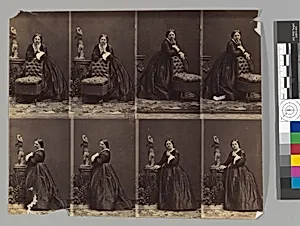
Medium
Albumen silver print from glass negative
Dimensions
Image: 18.5 × 22.7 cm (7 5/16 × 8 15/16 in.)
Classification
Photographs
Department
Photographs
Museum
Metropolitan Museum of Art, New York, NY
Credit
Gilman Collection, Gift of The Howard Gilman Foundation, 2005
Accession Number
2005.100.588.9
Rights
Public Domain
Tags
Art Historical Context
**Berthe**, a captivating portrait by pioneering French photographer André-Adol-Eugène Disd, dates to early 1862. Captured as an albumen silver print a glass negative, this18.5 × 22.7 cm image exemplifies the exquisite detail and warm tonality of mid-19th-century photography. Albumen prints, made by coating paper with egg whites mixed with light-sensitive silver salts, were the gold standard for portraits, yielding rich contrasts and fine textures that brought subjects vividly to life. Disdéri revolutionized photography with his invention of the *carte de visite* format around 1854—a small, affordable card-mounted photo that became a cultural sensation in Second Empire France. By 1862, millions were produced annually, traded like baseball cards among celebrities, royalty, and everyday folk. Though larger than the typical *carte*, *Berthe* reflects this craze, offering an intimate glimpse into bourgeois life. The subject's poised gaze and elegant attire evoke the era's fascination with personal identity and social display. Housed in the Metropolitan Museum of Art's Gilman Collection, this work highlights photography's shift from novelty to essential art form, democratizing portraiture for women like Berthe amid rapid industrialization and cultural change. A testament to Disdéri's mastery, it invites us to ponder the stories behind every preserved face.
About the Artist
André-Adolphe-Eugène Disdéri · 1819–1889
**André-Adolphe-Eugène Disdéri** (1819–1889) was a pioneering French photographer whose innovations transformed portraiture into a mass medium during the Second Empire. Born on March 28, 1819, in Paris, Disdéri pursued diverse careers in commerce, acting, and politics early on, while studying art amid personal hardships following his father's death, which compelled him to support his mother, sibli...