
Berthe Morisot
1872-1874
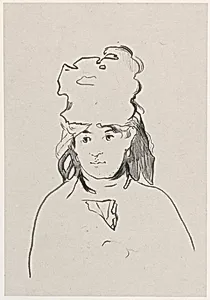
Medium
lithograph on chine collé on wove paper
Dimensions
sheet (chine collé): 23.7 × 16.5 cm (9 5/16 × 6 1/2 in.) support: 55.9 × 40.2 cm (22 × 15 13/16 in.)
Classification
Department
CG-E
Museum
National Gallery of Art, Washington, D.C.
Credit
Rosenwald Collection
Accession Number
1953.6.83
Rights
Public Domain
Art Historical Context
In the heart of Paris's vibrant art scene during the early 1870s, Édouard Manet created this intimate lithograph portrait of fellow artist Berthe Morisot, dated 1872–1874. Titled simply *Berthe Morisot*, the work captures the Impressionist painter in a moment of quiet intensity, her gaze direct and poised. Manet, a pivotal figure bridging Realism and Impressionism, produced several portraits of Morisot, his close friend and sister-in-law through marriage to his brother Eugène. This print exemplifies their artistic camaraderie amid the evolving avant-garde. Executed as a lithograph on chine collé—thin Chinese paper adhered to a sturdy wove support—the medium allowed for subtle tonal gradations and delicate lines, hallmarks of 19th-century printmaking. Measuring just 23.7 × 16.5 cm on the chine collé sheet, its intimate scale invites close viewing, highlighting Manet's mastery of light and form in monochrome. Housed in the National Gallery of Art's Rosenwald Collection (Department CG-E), it reflects the era's fascination with reproducible art that democratized access to elite portraits. This piece not only immortalizes Morisot as a trailblazing female artist but also underscores the gender dynamics of the Impressionist movement, where personal bonds fueled innovation. A testament to friendship and shared vision, it remains a gem for visitors exploring modernism's roots.
About the Artist
Edouard Manet · 1832–1883
Édouard Manet (1832-1883) was a French painter who played a pivotal role in the transition from Realism to Impressionism, often called the 'Father of Modern Art.' Born into a wealthy Parisian family, Manet defied his father's wishes for a legal career to pursue painting, studying under academic artist Thomas Couture. His revolutionary works 'Le Déjeuner sur l'herbe' and 'Olympia' (both 1863) scand...