
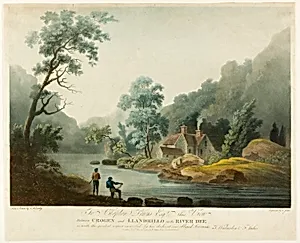
Between Crogen & Llandrillo on the R. Dee
published 1793
Medium
Color aquatint and etching on paper
Classification
aquatint
Department
Prints and Drawings
Museum
Art Institute of Chicago
Accession Number
15047
Rights
Public Domain
Art Historical Context
**Between Crogen & Llandrillo on the R. Dee** (1793) by Francis Jukes captures a serene stretch of the River Dee in Wales, nestled between the villages of Crogen and Llandrillo. Published during the late 18th century, this print reflects Britain's growing fascination with the Picturesque—a Romantic movement celebrating the wild beauty of the countryside amid the encroaching Industrial Revolution. Jukes, a skilled British printmaker, specialized in topographic views like this one, offering affordable glimpses of scenic Britain to a widening audience of collectors and travelers. The artwork's medium, color aquatint and etching on paper, showcases Jukes's mastery of innovative techniques. Aquatint, developed in the 1760s, uses resin-dusted plates and acid to create soft, tonal gradations mimicking watercolor washes, far surpassing traditional line etching for atmospheric landscapes. Hand-colored for vivid blues, greens, and earthy hues, it brings the river's shimmering waters and lush banks to life, making it a standout in the Art Institute of Chicago's Prints and Drawings collection. This piece holds cultural significance as part of the topographical print boom, preserving vanishing rural idylls while democratizing art. Visitors today can appreciate how Jukes bridged fine art and popular culture, inviting us to pause amid the Dee's timeless flow.
About the Artist
Francis Jukes · 1745–1812
Francis Jukes was born in 1745 in Martley, Worcestershire, and became one of England’s most prolific engravers and publishers of the late eighteenth and early nineteenth centuries. He began his career as a topographical painter before turning to etching and line engraving. He then mastered aquatint, a tonal printmaking process he learnt from the watercolourist Paul Sandby, becoming one of the earl...