
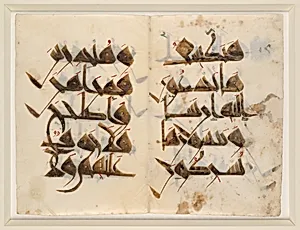
Bifolium from the "Nurse's Qur'an" (Mushaf al-Hadina)
Unknown Artist
ca. A.H. 410/ 1019–20 CE
Medium
Ink, opaque watercolor, and gold on parchment
Dimensions
H. 17 1/2 in. (44.5 cm) W. 23 5/8 in. (60 cm)
Classification
Codices
Department
Islamic Art
Museum
Metropolitan Museum of Art, New York, NY
Credit
Purchase, James and Diane Burke Gift, in honor of Dr. Marilyn Jenkins-Madina, 2007
Accession Number
2007.191
Rights
Public Domain
Art Historical Context
This bifolium comes from a Qur'an copied in North Africa to preserve the revealed text for recitation and study. The manuscript, known as the Nurse's Qur'an, was produced at a time when large-format copies on parchment were commissioned for major mosques, their pages turned slowly during communal readings. The script turns each Arabic letter into a heavy, rounded block linked by thin, extended strokes that cross the page like measured steps. Small red and green marks placed above and beside the words mark pronunciation and pauses, guiding the eye along the lines without breaking their steady rhythm. Made with ink, opaque watercolor, and gold on parchment around 1019–20, the bifolium now rests in the Metropolitan Museum of Art. Look at the lower right corner of the right page, where one elongated letter curves outward and nearly touches the margin, its thin tail countering the dense mass of shapes above.