
Folio from a Qur'an Manuscript
Unknown Artist
9th–early 10th century
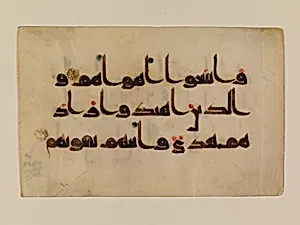
Medium
Ink, opaque watercolor, and gold on parchment
Dimensions
H. 3 5/16 in. (8.4 cm) W. 5 1/16 in. (12.9 cm)
Classification
Codices
Department
Islamic Art
Museum
Metropolitan Museum of Art, New York, NY
Credit
Rogers Fund, 1962
Accession Number
62.152.1
Rights
Public Domain
Tags
Art Historical Context
This exquisite folio from a'an manuscript, dating to the th–early 10th century, represents one of the earliest surviving examples of Islamic sacred texts. Crafted by an unknown artist using ink, watercolor, and gold on, it measures a compact 3 5/16 by 5 1/16 inches—ideal for portable devotional use during an era when the Qur'an was central to Muslim life and learning. In the Islamic world, calligraphy emerged as the preeminent art form, as the Qur'an's Arabic verses were considered divine and inimitable. Manuscripts like this were laboriously produced as acts of piety, with gold accents lending a luminous, heavenly quality to the text, evoking the eternal light of faith. The angular script and precise layout highlight the calligrapher's mastery, transforming words into visual poetry. Today, this treasure from the Metropolitan Museum of Art's Islamic Art collection (acquired via the Rogers Fund in 1962) offers a window into Abbasid-era reverence for scripture, reminding visitors of calligraphy's enduring role in preserving and honoring the sacred.