
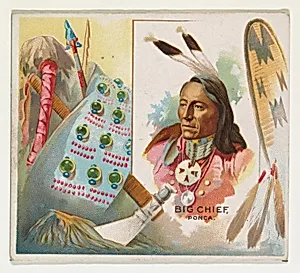
Big Chief, Ponca, from the American Indian Chiefs series (N36) for Allen & Ginter Cigarettes
1888
Medium
Commercial color lithograph
Dimensions
Sheet: 2 7/8 x 3 1/4 in. (7.3 x 8.3 cm)
Classification
Prints|Ephemera
Department
Drawings and Prints
Museum
Metropolitan Museum of Art, New York, NY
Credit
The Jefferson R. Burdick Collection, Gift of Jefferson R. Burdick
Accession Number
63.350.202.36.39
Rights
Public Domain
Tags
About this artwork
This prints|ephemera by american artist Allen & Ginter exemplifies the artistic achievements of 1888. American artists of this period were establishing distinct visual traditions while engaging with European artistic movements. The artist's work in commercial color lithograph demonstrates the importance of printmaking as both an artistic medium and a means of disseminating images widely. Executed in commercial color lithograph, this work demonstrates the sophisticated technical processes involve...
Art Historical Context
"Big Chief, Ponca is a captivating portrait from Allen & Ginter's American Indian Chiefs series (N), issued in 1888 as inserts in cigarette packs. These small chromolithographs fueled the era's collecting craze, introducing everyday Americans to images of Native leaders amid the fading frontier. Captured in vivid color, the card depicts a dignified Ponca chief, reflecting late 19th-century fascination with Indigenous cultures—often romanticized through popular media—while highlighting the company's innovative marketing. Printed as a commercial color lithograph on a modest sheet of 2 7/8 x 3 1/4 inches, this ephemera showcases the technical marvels of chromolithography. Multiple lithographic stones, each inked in a different hue, allowed for rich, layered colors and mass production, making high-quality art accessible beyond elite circles. Allen & Ginter, pioneers in the medium, transformed advertising into collectible art, blending artistry with commerce. Today, housed in the Metropolitan Museum of Art's Drawings and Prints department from the Jefferson R. Burdick Collection, this print illuminates 1888's cultural crossroads: printmaking's democratizing power and America's complex gaze on Native heritage. A tiny window into history, it reminds us how everyday objects preserve profound stories.
About the Artist
Allen & Ginter
Allen & Ginter, the pioneering American tobacco firm based in Richmond, Virginia, emerged around 1880 from the partnership of John F. Allen and Lewis Ginter, evolving from Allen's earlier John F. Allen & Company. Allen retired in 1882, succeeded by John Pope, yet the brand endured under Ginter's leadership, employing over 1,100 workers—mostly women—for hand-rolled cigarettes by 1886. Ginter, a Dut...