
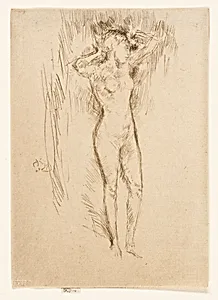
Binding the Hair
Medium
Etching with drypoint in black ink on cream laid paper
Dimensions
Image, trimmed within platemark: 13.3 × 9.5 cm (5 1/4 × 3 3/4 in.); Sheet: 13.6 × 9.5 cm (5 3/8 × 3 3/4 in.)
Classification
etching
Department
Prints and Drawings
Museum
Art Institute of Chicago
Accession Number
51033
Rights
Public Domain
Art Historical Context
James McNeill Whistler’s *Binding the Hair* (7) captures an intimate of a woman gracefully arranging her long tresses, rendered in the delicate medium of etching with drypoint on cream laid paper. Measuring just 13.3 × 9.5 cm, this small-scale print exemplifies Whistler’s mastery of printmaking during the late 19th century, a period when he championed Aestheticism and “art for art’s sake Rejecting narrative storytelling, Whistler focused on tonal harmony, subtle line work, and evocative atmosphere, influences drawn from his time in Venice and Paris. The etching technique involves incising lines into a metal plate with acid, while drypoint adds a soft, velvety burr from direct needle scratches—creating rich textures and depth in the woman’s flowing hair and draped figure. Whistler’s precise yet fluid lines evoke a sense of quiet elegance, blurring the line between portraiture and abstraction. Printed in black ink, the work’s trimmed format invites close viewing, highlighting his innovative approach to intimacy in art. Housed in the Art Institute of Chicago’s Prints and Drawings department, *Binding the Hair* reflects Whistler’s prolific 1880s output, where he explored domestic and feminine subjects with poetic restraint. It remains a gem for admirers of his subtle artistry, bridging Impressionist lightness with Japanese-inspired simplicity.
About the Artist
James McNeill Whistler · 1834–1903
James Abbott McNeill Whistler (1834-1903) was an American-born painter and printmaker who became a leading figure in the Aesthetic Movement and pioneer of Tonalism and Japonisme. He revolutionized art by championing "art for art's sake" and treating paintings as visual equivalents of musical compositions, titling works as "arrangements," "harmonies," and "nocturnes" to emphasize formal qualities o...