
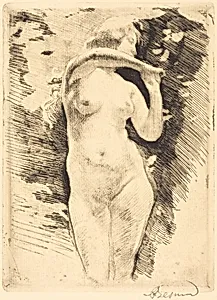
Eve
1886
Medium
etching on laid Van Gelder paper
Dimensions
plate: 17.8 × 13 cm (7 × 5 1/8 in.) sheet: 22.4 × 17.1 cm (8 13/16 × 6 3/4 in.)
Classification
Department
CG-E
Museum
National Gallery of Art, Washington, D.C.
Credit
Rosenwald Collection
Accession Number
1943.3.1471
Rights
Public Domain
Art Historical Context
Albert Besnard's *Eve* (1886) is a captivating etching that evokes the timeless biblical figure, rendered with the artist's characteristic flair for dramatic form and subtle emotion. Created during the late 19th century in France—a period when Symbolism and fin-de-siècle aesthetics were blossoming—Besnard, a prominent painter and printmaker, drew on mythological themes to explore human sensuality and the divine. This intimate plate (17.8 × 13 cm) captures Eve's essence on laid Van Gelder paper, a premium Dutch handmade stock favored by master printmakers for its textured surface that enhances ink retention and tonal depth. Etching, Besnard's chosen medium, exemplifies the 19th-century revival of intaglio techniques, allowing artists to achieve exquisite line work and rich velvety blacks through acid-bitten plates. The sheet's modest size (22.4 × 17.1 cm) invites close viewing, revealing the meticulous craftsmanship that made Besnard a leader in French graphic arts. Housed in the National Gallery of Art's Rosenwald Collection—a treasure trove of prints—this work underscores the era's fusion of technical innovation and narrative allure, offering visitors a window into Eve's mythic allure through Besnard's masterful hand.
About the Artist
Albert Besnard · 1849–1934
Paul-Albert Besnard, known as Albert Besnard, was born on June 2, 1849, in Paris to an artistic family: his father, Louis Adolphe Ferdinand Besnard, was a history painter and pupil of Ingres, while his mother, Marie Louise Pauline Vaillant, was a noted miniaturist trained under Lizinska de Mirbel. Precociously talented, he began his training under Jean-François Brémond before entering the École de...