
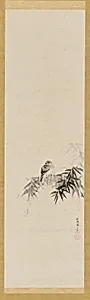
Bird on a bamboo branch
17th century
Classification
Painting
Department
Smithsonian Collection
Museum
Smithsonian American Art Museum
Credit
Gift of Charles Lang Freer
Accession Number
F1904.367
Rights
Public Domain
Tags
About this artwork
To 1904
Art Historical Context
Kano Tan'yu (1602–1674) was one of the most influential painters of Japan’s Edo period, serving as the official artist to the Tokugawa shogunate. As the leading figure of the Kano school, he helped shape the refined, elegant style that defined official and aristocratic art for generations. His works often drew on classical Chinese themes while incorporating a distinctly Japanese sensitivity to nature’s quiet beauty. “Bird on a Bamboo Branch,” created in the 17th century, exemplifies this tradition. The subject of a solitary bird perched on bamboo carries rich cultural resonance: bamboo symbolizes resilience and integrity, while birds frequently evoke freedom or seasonal change. Though the exact medium remains unrecorded, Kano painters typically worked in ink on paper or silk, using delicate brushwork to suggest both form and spirit with economical strokes. Now part of the Smithsonian American Art Museum through the generosity of collector Charles Lang Freer, the painting offers visitors a glimpse into the refined aesthetic world of Edo-period Japan. Its presence in an American collection highlights the long-standing appreciation for Japanese art beyond its homeland.