
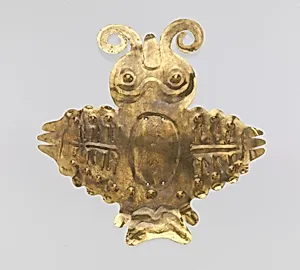
Bird-shaped ornament
100 BCE–700 CE
Medium
Gold
Dimensions
H. 4 7/8 × W. 4 7/8 × D. 1/8 in. (12.4 × 12.4 × 0.3 cm)
Classification
Metal-Ornaments
Culture
Nasca
Department
Arts of Africa, Oceania, and the Americas
Museum
Metropolitan Museum of Art, New York, NY
Credit
The Michael C. Rockefeller Memorial Collection, Bequest of Nelson A. Rockefeller, 1979
Accession Number
1979.206.511
Rights
Public Domain
Art Historical Context
This exquisite bird-shaped ornament, crafted by Nasca artists between 100 BCE and 700 CE, exemplifies the masterful metalworking of ancient Peru's Nasca culture in southern Peru Fashioned from thin sheets of gold—measuring just 4⅞ × 4⅞ inches and a mere ⅛ inch thick—this delicate piece likely served as an ear ornament or pectoral adornment for elites. Gold held profound symbolic value in pre-Columbian Andean societies, representing the sun's divine light and associated with power, fertility, and the cosmos. The Nasca are celebrated for their vibrant iconography, where birds dominate motifs on pottery, textiles, and geoglyphs like the famous Nazca Lines. This avian form, with its stylized wings and beak, evokes mythical creatures or deities central to Nasca cosmology, possibly linking the earthly and supernatural realms. Artisans employed sophisticated techniques such as hammering and repoussé to create intricate details from fragile gold sheets, showcasing technical virtuosity and aesthetic refinement. Housed in The Metropolitan Museum of Art's Michael C. Rockefeller Memorial Collection, this ornament offers a glimpse into Nasca society's artistic ingenuity and spiritual worldview, bridging everyday adornment with profound cultural symbolism.