
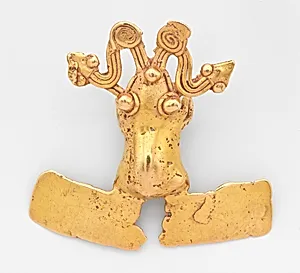
Frog Pendant
Unknown Artist
11th–16th century
Medium
Gold (cast)
Dimensions
H. 2 3/4 × W. 2 7/8 × D. 7/8 in. (7 × 7.3 × 2.2 cm)
Classification
Metal-Ornaments
Culture
Chiriqui
Department
Arts of Africa, Oceania, and the Americas
Museum
Metropolitan Museum of Art, New York, NY
Credit
The Michael C. Rockefeller Memorial Collection, Bequest of Nelson A. Rockefeller, 1979
Accession Number
1979.206.910
Rights
Public Domain
Tags
Art Historical Context
This exquisite Frog Pendant, crafted by an unknown artist of the Chiriqui culture in western Panama, dates to the 11th–16th centuries. Measuring just 2¾ × 2⅞ × ⅞ inches, this cast gold ornament captures the lively form of a frog in intricate detail, its compact size suggesting it was worn as personal jewelry—perhaps suspended from a necklace or belt. Housed in The Metropolitan Museum of Art's Department of the Arts of Africa, Oceania and the Americas, it part of The Michael C. Rockefeller Memorial Collection, a bequest that highlights exceptional pre-Columbian treasures. The Chiriqui people were masterful goldsmiths, renowned for their zoomorphic designs that blended everyday animals with symbolic motifs. Frogs, in particular, appear frequently in their metalwork, possibly evoking themes of fertility, water, or transformation central to indigenous cosmologies. The pendant's creation via lost-wax casting—a sophisticated technique involving sculpting a wax model, encasing it in clay, and pouring molten gold—demonstrates the culture's advanced metallurgy, which flourished before European contact. As a fine example of Chiriqui metal ornaments, this piece offers a window into a vibrant pre-Columbian society, where gold not only signified wealth and status but also connected wearers to the natural and spiritual worlds. Visitors can marvel at its shimmering realism, a testament to enduring artistic ingenuity.