
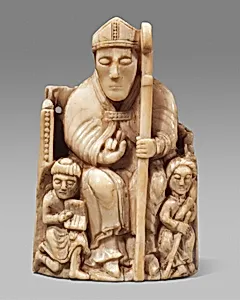
Bishop Chess Piece
Unknown Artist
1150–1200
Medium
Walrus ivory
Dimensions
Overall: 3 3/4 x 2 1/2 x 1 7/16 in. (9.6 x 6.3 x 3.6 cm)
Classification
Ivories-Walrus
Culture
Scandinavian
Department
Medieval Art
Museum
Metropolitan Museum of Art, New York, NY
Credit
Gift of J. Pierpont Morgan, 1917
Accession Number
17.190.229
Rights
Public Domain
Tags
About this artwork
This medieval chess piece represents a bishop seated with smaller attendant figures, carved from walrus ivory in Scandinavia between 1150 and 1200. The piece stands approximately three and three-quarter inches tall and depicts the bishop as a figure of authority, accompanied by what appear to be clerical assistants. One smaller figure, identified as a Reader, holds the bishop's book, representing the ecclesiastical officials who served in ceremony. The carving demonstrates the sophisticated ivor...
Art Historical Context
This exquisite walrus ivory chess piece carved in Scandinavia around 1150–1200, depicts a seated bishop flanked by smaller attendant figures, likely clerical assistants. One holds the bishop's, symbolizing ecclesiastical hierarchy and ceremony. Standing just under 4 inches tall, the sculpture showcases masterful medieval ivory-working techniques: intricate folds in robes, poised postures, and subtle details that convey authority despite the miniature scale. Likely from Trondheim, Norway—a hub for walrus ivory carving supplied by local hunters—this piece highlights northern Europe's adaptation of exotic materials over elephant ivory. Introduced to European chess in the 12th century, the bishop replaced the Islamic game's elephant, fittingly so as medieval bishops often joined armies on campaign. This cultural shift reflects how chess evolved to mirror Christian society, blending strategy with symbolism. The use of durable walrus tusk underscores regional craftsmanship and trade networks. Donated to The Metropolitan Museum of Art in 1917 by J. Pierpont Morgan, it featured in the 2011–2012 Cloisters exhibition "The Game of Kings," celebrating medieval chessmen's role in art and leisure. A charming glimpse into Viking-era ingenuity and chivalric play.