
Bishop Hill: Church Pew
1939
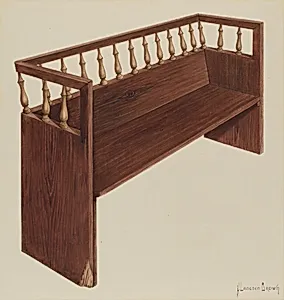
Medium
watercolor, graphite, and pen and ink on paper
Dimensions
overall: 40.4 x 33.6 cm (15 7/8 x 13 1/4 in.)
Classification
Index of American Design
Department
CG-W
Museum
National Gallery of Art, Washington, D.C.
Credit
Index of American Design
Accession Number
1943.8.3920
Rights
Public Domain
Art Historical Context
In the quaint village of Bishop Hill, Illinois—a 19th-century Swedish utopian colony founded by Erik Jansson in 1846—this church pew captures the simple, sturdy craftsmanship of early American folk design. Rendered in 1939 by artist. Langden Brown as of the Index of American Design, a New Deal-era Federal Art Project, the watercolor, graphite, and pen-and-ink drawing preserves the pew's hand-hewn wooden form, with its slanted backrest and modest proportions suited to communal worship. Bishop Hill's communal life emphasized piety and self-reliance, reflected in such unadorned furniture that blended Scandinavian influences with frontier practicality. The Index of American Design (1935–1942) commissioned artists like Brown to document everyday objects, ensuring America's design heritage endured amid the Great Depression. Brown's meticulous technique—layering translucent watercolors for realistic shading, graphite for fine details, and ink for crisp outlines—elevates the humble pew into a vibrant study, highlighting its cultural role in immigrant communities. Today, housed in the National Gallery of Art, this 15⅞ × 13¼-inch work invites us to appreciate how folk art wove together faith, migration, and ingenuity in shaping the nation's identity.
About the Artist
H. Langden Brown · 1879–1960
H. Langden Brown (1879–1960) was an American artist best known for his contributions to the Index of American Design, a Federal Art Project under the Works Progress Administration (WPA) from 1935 to 1942. This ambitious initiative commissioned artists across the United States to create meticulous watercolor renderings of everyday objects, tools, vehicles, and crafts that embodied the nation's folk...