
Bishop Hill: Flail
c. 1939
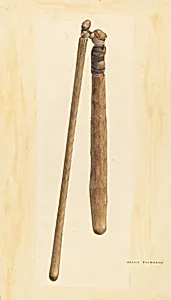
Medium
watercolor and graphite on paperboard
Dimensions
overall: 35.5 x 26.9 cm (14 x 10 9/16 in.) Original IAD Object: handle: 50" long; flail: 40" long; 2" wide tapering to 1 1/2"
Classification
Index of American Design
Department
CG-W
Museum
National Gallery of Art, Washington, D.C.
Credit
Index of American Design
Accession Number
1943.8.3914
Rights
Public Domain
Art Historical Context
**Bishop Hill: Flail by Archie Thompson (c. 1939) captures a humble yet vital tool from the historic Swedish utopian community of Bishop Hill, Illinois. Founded in the 1840s by religious leader Erik Jansson, Bishop Hill was a thriving settlement known for its folk crafts and agricultural self-sufficiency. This watercolor and graphite rendering on paperboard meticulously documents a traditional wooden flail—a handheld threshing instrument with a 50-inch handle connected to a 40-inch swiple—used to separate grain from chaff before modern machinery. As part of the Federal Art Project's Index of American Design (IAD), Thompson's work preserves everyday American folk objects, celebrating regional craftsmanship during the Great Depression. Rendered at 35.5 x 26.9 cm, the piece showcases Thompson's precise graphite outlines enhanced by subtle watercolor washes, highlighting the flail's ergonomic form tapering from 2 to 1.5 inches. This technique exemplifies the IAD's goal: to create faithful, artistic records blending technical accuracy with aesthetic appeal, influencing later American design appreciation. Housed in the National Gallery of Art's collection, this artwork underscores Bishop Hill's cultural legacy—now a state historic site—and the flail's role in pre-industrial farming. It invites visitors to reflect on immigrant ingenuity and the beauty in utilitarian design.
About the Artist
Archie Thompson · 1886–1975
Archie Thompson is an artist whose presence in museum collections, represented by a substantial body of recorded works, testifies to a productive career that the broader art-historical record has not yet fully documented. His dates and nationality remain unrecorded in the sources currently available, leaving the particular tradition and training context from which he emerged difficult to specify w...