
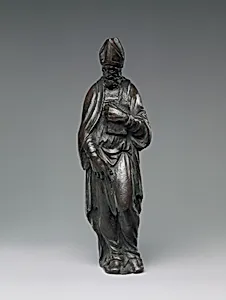
Bishop (Saint Augustine?)
1550–1600
Medium
Bronze
Dimensions
Overall (confirmed): 6 1/2 × 2 × 1 5/8 in. (16.5 × 5.1 × 4.1 cm)
Classification
Sculpture-Bronze
Culture
Italian, possibly Florence
Department
European Sculpture and Decorative Arts
Museum
Metropolitan Museum of Art, New York, NY
Credit
Rogers Fund, 1908
Accession Number
08.175.10
Rights
Public Domain
Tags
Art Historical Context
This exquisite bronze sculpture, titled *Bishop (Saint Augustine?)*, is attributed to Jacopo Sansov (Jacopo Tatti), a leading Italian artist of the High Renaissance who bridged classical ideals with emerging Mannerist elegance. Created between 1550 and 1600, likely in Florence, it captures the poised dignity of a bishop—possibly Saint Augustine, the influential 4th-century theologian and Doctor of the Church. At just 6½ inches tall, this intimate tabletop figure exemplifies the Renaissance fascination with small-scale bronzes, prized by collectors for their lifelike presence and portability. Sansovino's mastery shines in the lost-wax casting technique, which allowed for intricate details like the flowing vestments, furrowed brow, and subtle gestures of benediction. The rich patina of the bronze enhances its solemnity, evoking the sacred aura of ecclesiastical portraits amid Italy's Catholic revival. Such works reflected the era's blend of humanism and piety, commissioned by elite patrons to adorn private chapels or studioli. Acquired through the Rogers Fund in 1908, this piece from the Metropolitan Museum of Art's European Sculpture collection invites us to ponder a saint's contemplative wisdom, frozen in enduring metal. A testament to Sansovino's Venetian-Florentine legacy, it reminds visitors of art's power to bridge centuries.