
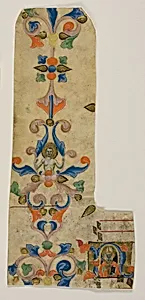
Bishop Saint Zenobius in a Historiated Initial "N" with Decorated Border from a Laudario
Medium
Manuscript cutting with tempera and gold leaf decorations, and rounded gothica textualis inscriptions in black ink, ruled in red ink, on parchment
Dimensions
21.3 × 9.7 cm (8 7/16 × 3 7/8 in.)
Classification
tempera
Department
Prints and Drawings
Museum
Art Institute of Chicago
Accession Number
123556
Rights
Public Domain
Art Historical Context
Nestled within the ornate initial "N" of this exquisite manuscript cutting, Bishop Saint Zenobius, Florence's revered patron saint, stands in solemn blessing. Created around 1340 by the anonymous Master the Dominican Effigies Florentine illuminator renowned vivid depictions of Dominican saints—this piece hails from a *laudario*, a devotional book of lauds (hymns) sung by lay confraternities during religious processions and services. These books were vital to medieval Italian piety, blending music, prayer, and visual splendor to inspire communal devotion. The historiated initial, framed by a delicate decorated border, exemplifies Trecento illumination techniques. Tempera paints on parchment, enriched with shimmering gold leaf, create a luminous effect that would have glowed under candlelight in dimly lit chapels. Ruled in red ink with rounded gothica textualis script in black, the 21.3 × 9.7 cm fragment reveals meticulous craftsmanship—every fold of Zenobius's robes and glint of his mitre crafted to draw the eye and elevate the sacred word. Today, housed in the Art Institute of Chicago's Prints and Drawings department, this survivor of a once-grand codex offers a window into 14th-century Florence's vibrant religious culture, where art and faith intertwined to honor saints like Zenobius, protector against disasters.