
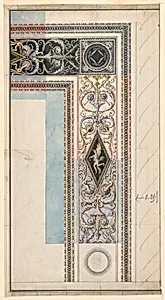
Design for a Door Frame
1800–1825
Medium
drawing
Classification
drawing
Department
Smithsonian Collection
Museum
Smithsonian American Art Museum
Credit
Purchased for the Museum by the Advisory Council
Accession Number
1911-28-258
Rights
Public Domain
About this artwork
Research in Progress
Art Historical Context
**Design for a Door Frame by Charles Percier (, 1764–1838) is a delicate drawing from around 1800–1825, now housed in the Smithsonian American Art's Smithsonian Collection. Purchased the Advisory Council, this work exemplifies Percier's mastery as a leading neoclassical architect and interior designer France's Napoleonic era. Collaborating closely with Pierre-François-Léonard Fontaine Percier shaped the opulent Empire style, blending ancient Roman grandeur with modern elegance for imperial palaces like the Tuiler and Malmaison. Created as a preparatory drawing, this design for a door frame highlights the precision of 19th-century architectural drafting techniques. Such sketches were essential blueprints for craftsmen, capturing intricate moldings, proportions, and ornamental details inspired by antiquity—think acanthus leaves or laurel motifs—that symbolized power and refinement. Percier's influence extended to furniture, textiles, and state rooms, making his designs pivotal in defining post-Revolutionary French taste. Though research on this piece is ongoing, it offers a window into how neoclassical ideals transformed everyday architecture into statements of prestige. Visitors can appreciate how a simple door frame could embody the era's cultural rebirth, bridging art and function in Napoleon's glittering world. (198 words)