
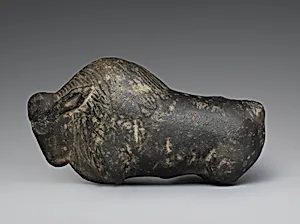
Bison figure
Unknown Artist
3rd millennium BCE
Medium
Marble
Dimensions
4.72 x 3.07 x 7.95 in. (11.99 x 7.8 x 20.19 cm)
Classification
Stone-Sculpture
Department
Ancient Near Eastern Art
Museum
Metropolitan Museum of Art, New York, NY
Credit
Gift of Norbert Schimmel Trust, 1989
Accession Number
1989.281.2
Rights
Public Domain
Tags
Art Historical Context
This exquisite **Bison figure**, carved from marble in the 3rd millennium, transports visitors to the dawn of Ancient Near Eastern civilization—roughly the Early Dynastic period in Mesopotamia and surrounding regions. Standing just 4.72 x 3.07 x 7.95 inches, this compact stone sculpture captures the bison's robust form with remarkable simplicity and vitality, its smooth surfaces polished to highlight the stone's natural veining. Marble, though less common than limestone in the region, underscores the sculptor's access to prized materials, likely sourced through trade networks spanning Anatolia or the Iranian plateau. Animal figures like this bison were central to Near Eastern art, often embodying raw power, fertility, or divine attributes in a world where wildlife symbolized the untamed forces of nature. The unknown artist's technique—precise undercutting and subtle modeling—reveals advanced stoneworking skills honed over generations, transforming a humble block into a timeless emblem. Such small-scale sculptures might have served as votive offerings in temples or personal talismans, bridging the human and spiritual realms. A generous gift from the Norbert Schimmel Trust in 1989, this piece now anchors the Metropolitan Museum of Art's Ancient Near Eastern collection, inviting us to ponder the enduring human fascination with the wild. (198 words)