
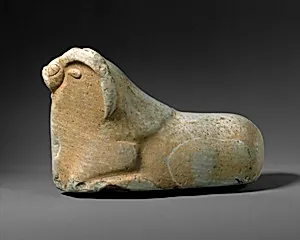
Reclining mouflon
Unknown Artist
ca. 2600–1900 BCE
Medium
Marble
Dimensions
L. 28 cm
Classification
Stone-Sculpture
Culture & Period
Indus · Mature Harappan
Department
Ancient Near Eastern Art
Museum
Metropolitan Museum of Art, New York, NY
Credit
Purchase, Anonymous Gift and Rogers Fund, 1978
Accession Number
1978.58
Rights
Public Domain
Tags
Art Historical Context
Behold the *Reclining Mouflon*, a delicate marble sculpture from the Mature Harappan period of the Indus Valley Civilization (ca. 2600–1900 BCE). Carved from a single block of marble, this 28 cm long figurine captures a wild sheep in a serene, reclining pose, evoking the natural world that sustained one of the world's earliest urban societies in present-day Pakistan and northwest India. Discovered among artifacts of this flourishing culture, known for its advanced cities like Mohenjo-daro and Harappa, the piece reflects the Harappans' mastery of stone carving during their mature phase. Marble, a relatively rare medium for Indus art—more commonly seen in terracotta or steatite—highlights the sculptor's skill in rendering smooth contours and subtle anatomical details, from the curved horns to the relaxed musculature. Animals like the mouflon, a wild ancestor of domestic sheep, frequently appear in Harappan iconography, possibly symbolizing fertility, vitality, or ritual significance, though their exact meaning remains a tantalizing mystery. Acquired by The Metropolitan Museum of Art in 1978, this understated gem invites us to ponder the daily life and spiritual worldview of an ancient people who built without kings or palaces, yet left behind such refined artistry. A quiet testament to human creativity across millennia.