
Black and Yellow Warbler
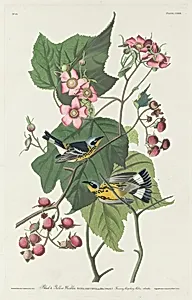
Medium
hand-colored engraving and aquatint on Whatman wove paper
Classification
Department
CG-W
Museum
National Gallery of Art, Washington, D.C.
Credit
Gift of Mrs. Walter B. James
Accession Number
1945.8.123
Rights
Public Domain
Art Historical Context
Behold the vibrant *Black and Yellow Warbler* (1831), a stunning print from John James Audubon's groundbreakingBirds of America*, engraved by Robert Havell Jr. after Audubon's original watercolor. Published during the height of 19th-century natural history fervor, this plate captures the warbler's delicate black-and-yellow plumage and lively perch amid botanicals, exemplifying Audubon's revolutionary approach to avian portraiture. Unlike static scientific illustrations of the era, Audubon's birds burst with dynamic energy, posed as if in mid-flight or song, blending art with empirical observation to inspire awe in viewers. Crafted as a hand-colored engraving and aquatint on fine Whatman wove paper—a premium British stock prized for its texture and durability—Havell's masterful technique allowed for intricate line work and subtle tonal gradations. Aquatint lent a painterly softness to feathers and foliage, while hand-coloring by skilled artisans ensured each of the edition's copies glowed with lifelike vibrancy. This double-elephant folio series (1827–1838), comprising over 400 plates, remains one of the most ambitious and expensive publications in history, transforming ornithology into high art. Today, housed in the National Gallery of Art as a gift from Mrs. Walter B. James, this print celebrates America's natural wonders and the era's passion for exploration. It invites us to marvel at the warbler's fleeting beauty, a testament to Audubon's vision that birds are not mere specimens, but living poetry of the wild.
About the Artist
Robert Havell after John James Audubon
Robert Havell Jr., born on November 25, 1793, in Reading, Berkshire, England, was the son of renowned engraver and publisher Robert Havell Sr. and Lydia Miller Phillips. Growing up in a family of artists that included notable engravers and etchers, he trained under his father, mastering aquatint techniques early on. Though briefly estranged from the family business, Havell reconciled with his fath...